Tuesday, November 12, 2013

It don't mean a thing (if it ain't got that swing).


Have you ever had that foreboding premonition that you've forgotten something or that something wasn't quite right, but for the life of you, you just can't put a finger on it?  That happened to your diarist as he drove over to the rink yesterday afternoon all set to work on the Canasta Tango.  No, I didn't forget my skates.  Haven't done that yet.

I drove to the rink and wondered if the noon to 2 pm public would be crowded since many, like me, had off for Veteran's Day.  To my surprise the place was empty.  I laced up my boots and got out on the ice and took my customary four laps of the rink to warm up my legs.  When I arrived at the far end of the rink after the fourth circuit, I reached into my jacket pocket to pull out the Canasta Tango diagram only to find pocket lint.  It was then that the penny dropped.  I'd left my little map, home, on the computer table!  I exited the ice and clomped into the rink office hoping to find a coach with a rulebook so to make a quick photocopy of the required page.  Not a single coach was to be found.  What to do?  I decided I wasn't going to waste valuable ice time by going home to retrieve the diagram.  After all, I told myself, there are plenty of other things in my skating repertoire that need work.

I decided to work on back skating elements since the rink population seemed manageable--just one quality skater working on a moves pattern and a family of ice tourists who were enjoying a rare day off for both parents and small fry. I decided that the elements du jour would be cutbacks and back outside swing rolls.  My goal was to get to the point where I wasn't hesitant to circuit the rink doing alternating cutbacks down one side of the ice and back swing rolls up the other.  My cutbacks are OK but nothing to write home about, especially the clock-wise one.  This is odd because clock-wise is my easy direction for most other elements like 3-turns and Mohawks.

Back swing rolls on the other hand are relatively new to me and swinging the free leg back while facing outside of the circle and not feeling like I'm losing the respective back outside edge is a little spooky.  Sometimes it works and other times not so much.  It was one of those deals where I couldn't define why the element worked when it did.  So I started experimenting with arm and free leg positions.  I soon worked out that if I looked over my skating arm while keeping my free leg close to my skating leg, during the swing, that the roll was controllable.  In a short period of time I was able knit together successive, smooth swing rolls much to the entertainment of the ice tourist mother who had the mildly distracting habit of following me at close quarters--all the while grinning like a Cheshire cat.  I could see her wobbling in an alarming way, out of the corner of my eye, but decided that so long as I could keep track of her position and the varying locations of her brood, things would probably remain copacetic.  As the session wore on, I was able to swing my way around the rink and the rolls felt fairly comfortable.  We'll see if I still have them under control when Kelly and I have our next lesson.  Just as importantly, I'll get feedback on whether my technique is OK or if I have another batch of bad habits to unlearn. As for my cutbacks, they seemed to have benefited from my earlier work with those swing rolls.  A lot less scritchy-scratchy stuff was going on and I felt more confident while doing the clock-wise swizzle push into my shaky direction.

And so the session went.  I alternated between cutbacks and back outside swing rolls, with an occasional Dutch Waltz thrown in (casual observation: ever notice how kids tend to congregate at the middle or end of a lobe in your pattern?  Corollary question: how do they know where those places are if they don't dance?) and marveled at how quickly the two hours evaporated.  Glad I only wasted ten minutes trying to find a rule book!

Sunday, November 10, 2013

Forward Progress: I pass ISI Dance Level 1, come to grips with the Dutch Waltz and Canasta Tango and meet a competitive ice dance pair right here in Bowie (who knew?).

Yesterday I had my third ice dance lesson with Coach Kelly.  She wanted to see if I'd been goofing off during the intervening week.  I hadn't; I was lucky enough to get to a lightly populated public session mid-week and took the opportunity to practice the Dutch Waltz without other skaters getting in the way.  Instead of over-thinking things and worrying about beats per step, I concentrated on getting the dance to fit the  mandatory pattern on the rink.  I figured if I got the pattern were it was supposed to be on the ice, the beats would eventually take care of themselves.

So to answer her question about how things were going I asked her to critic my Dutch Waltz and proceeded to skate the dance and more or less placed all the lobes where they're supposed to be.  She was both pleased and surprised and asked if I wanted to get started on the Canasta Tango.  I told her that she should first test me for the two items that make up ISI's Dance level 1: two mandatory patterns, one of which is a Chasse sequence the other a Progressive sequence. Those can be seen here along with the forward swing roll pattern which is part of Dance level 2.  Bottom line: I passed the three patterns and Kelly said she'd make me a CD with music for the Dutch Waltz, Canasta Tango and Rhythm Blues.  In order to pass actual dances one must skate to the music.  The addition of music will no doubt be interesting and frustrating at the same time.  Interesting because adding music will make all this seem more like a dance.  Frustrating because the music will add another level of complexity to keep track of while skating the steps.   That said, we moved on to spend the last 10 minutes of lesson time looking at the Canasta Tango.

The Canasta Tango has fewer steps than the Dutch Waltz (14 vs 16) but is a much busier dance.  As with the Dutch Waltz, the dance uses one side of the rink and the dog bone shaped pattern (below) represents two passes of the dance.  This dance is "busier" because unlike the preceding Dutch Waltz which has only one skating element going on in each lobe of the dance (a progressive, a swing roll or a pair of forward edges), the Canasta Tango has several things going on in each lobe.  For example, lobe one has a progressive, a chasse step and a swing roll all compressed within that first lobe.  Additionally, this dance introduces dancers to the slide chasse (step 7) and the extra complication of an optional cross roll at step 14.  With Kelly, the cross roll will NOT be an option.

The Canasta Tango pattern is skated in reverse Kilian position; i.e. the lady is to the left of the man.

Today, diaristdaughter and I went to the afternoon public session.  It was crowded, and for the first hour one end of the rink was annoyingly coned off for a birthday party.  I was busy practicing back swing rolls when all of a sudden a pair of adult skaters came onto the ice and one glance was enough to tell me that they had to be dancers--they were simply too smooth to be anything else.  I skated over and made their acquaintance.  It turns out that they were a local team returning to competition after a three year hiatus.  They train elsewhere but like Bowie ice for practice since it's close to where they live.  I told them I hope to see them often.  Bowie needs more dancers.

Friday, November 8, 2013

Mommy--that old man on skates is scaring me (again).

And you thought Halloween was over!  No, this is not your old diarist.  Although my skating probably does scare large and small ice tourists, sadly, I can't jump this high.  Love the costume though.  It's hard to top the 1930s for drama.


Red McCarthy in full flight as the "King Bat" during a 1936 performance at the Sports Stadium in Brighton, UK.  It took  over an hour for Red to be painted with silver paint before each show and just as long to remove it afterwards.  You can read a bit more here: http://www.mybrightonandhove.org.uk/page_id__6503_path__191p982p.aspx . 


Photo: Illustrative image for the 'S.S. Brighton' page
The Sports Stadium started life as an indoor salt water swimming facility.  While it intially proved quite popular, a succession of warm summers caused a decline in popularity as the public preferred outdoor ocean bathing.  In response to the decline the management decided to convert the facility into an indoor ice rink.


Photo:Souvenir Brochure, opening of the Swimming Stadium, Brighton. 1934
A rendition of the indoor pool from the original 1934 promotional brochure.

Getting back to Red, he started his skating career as a barrel jumper and Canadian Olympic team member but quickly found that the theatrical side of skating was more lucrative.


http://www.hollywoodmuse.com/ice_classics/photos/1932%20Olympics.jpg
After the "King Bat" days, Red found work in American with the Ice Capades during the immediate pre-world war two era.  Here is a youtube video of Red from the 1941 show.  Red apparently never gave up his speed skates or his role as a "fantastic creature".  Could you do a Waltz jump on speed skates?  Amazing stuff!


Saturday, November 2, 2013

The Dutch Waltz: Twerking hard or hardly twerking?

http://0.tqn.com/d/figureskating/1/G/K/-/-/-/partners.jpg
The Kilian Position


Today my coach introduced me to the first of three preliminary pattern dances, the venerable Dutch Waltz.  She also introduced me to the most basic of dance holds, the Kilian Position.  For the benefit of the over flow viewers from my other blog, the Kilian Position is as follows: the two partners face the same direction with the lady to the right of the man and slightly ahead of him.  The man holds the lady's left hand in his left hand and places his right hand on the right side of her waist.  The lady places her right hand on top of the man's and forms a triangle with her arm by bending the elbow.

After adopting this position we pushed off and skated in a drunken stagger down the long axis of the rink.  I was simultaneously attempting to remember and then skate the basic pattern which she had only moments before outlined: a left progressive followed by a right and then left swing roll and another progressive, this time to the right.  The dance continues with a LFO edge, a RFI edge, another left progressive into a RFO swing roll finishing with another pair of LFO/RFI edges.  At this point the dance pattern repeats down the other side of the ice.  The test involves three repeats of the pattern or basically one and a half laps of the rink:


I say a drunken stagger because this very unschooled dancer was constantly out of step with his partner and consequently we were alternatively tugging each other or bumping shoulders.  Can you say synchronicity--that lilting, graceful flow of two skaters skating as one?  Easy enough to say, very much harder to do!

Here's a youtube video of well known ice dancers Terri Levine and Mike Ricigliano showing proper form for the Dutch Waltz:


The coach spent our remaining time demonstrating back swing rolls, which she said I'll soon need.  These I was able to mimic in a crude way which, like the Dutch Waltz, will take much refinement.  At this point our thirty minutes was up.  No blood was drawn and I used the remainder of the session to practice those back swing rolls.

Monday, October 21, 2013

And so it begins.

Last Saturday I had my first private ice dance lesson.  I'm starting off at the bottom of the ISI dance ladder, learning (at least attempting to learn) the mandatory patterns for chasses, progressives, and forward swing rolls.  It seems that my life has been taken over by little maps and diagrams:

For the Chasse Sequence, after the entry steps, one holds a LFO edge for a count of two, lifts the left foot on the count of three (while on a RFI edge) and then finishes on a LFO edge to the count of four.  The pattern repeats on a RFO edge as one moves down the long axis of the rink.  At least I think that's what's going on.


The Progressive Sequence is similar but with a cross over (actually, a more refined "cross under") replacing the Progressive's lift at the three count.


For me, the Swing Rolls, each held for a count of six was the easiest.  I probably looked like an idiot going down the long axis silently mouthing one, two, three, four, five, six over and over...


So far I've been spared the typically dreadful music that accompanies low level patterns but I assume that will end soon.  In the meantime let's listen to something soothing.  If you ever get a miserable song stuck in your head, just hum the tune "the girl from Ipanema" and your misery will be over.

WARNING: under no circumstance should you ever sing the actual words from that song.  If you do then "the girl from Ipanema" will replace the first stuck song, and for that predicament there is no known antidote.

I'll not have a lesson this coming Saturday as the rink is given over to a Halloween party (free admission if you wear a costume or bring can goods for charity; I plan on doing both).  So, I get a week's reprieve before coming to grips with the  Dutch Waltz.  More then.  Ta.


Friday, October 11, 2013

Steppin' Out

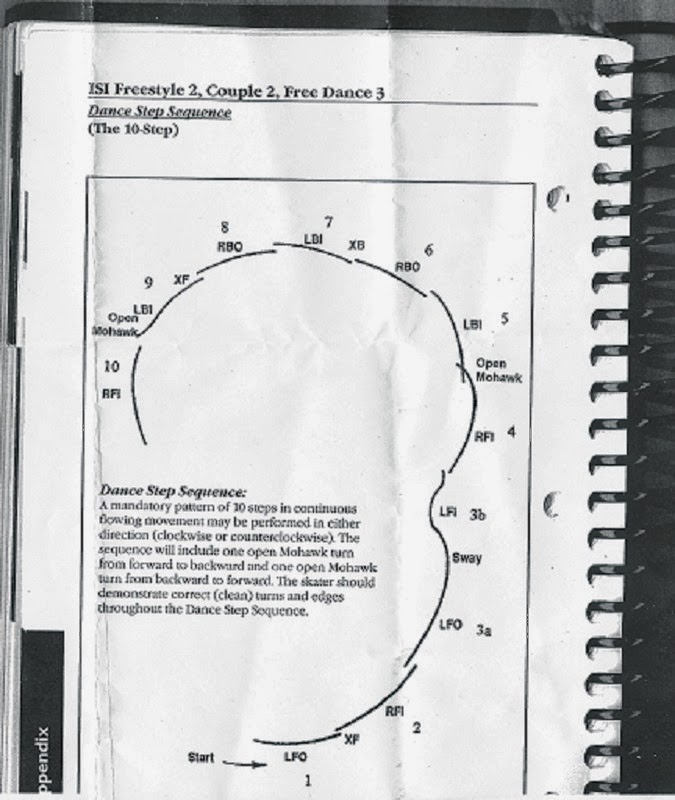
FS-1 celebration is over.  I'm now coming to grips with the elements in FS-2, one of which is this 10-step dance sequence.  Apologies for the slightly crumbled copy but I needed it at first because although there are only ten steps I just couldn't keep them straight without a road map. I stuffed it in my pocket while attempting to run through the thing. The "sway" after the initial cross-over is just a left foot edge change before the open Mohawk.  The step behind (step Nr 7) isn't too bad as long as I keep the preceding Mohawk well checked and remember to bend my knees enough to keep the knee cap over the toes during that maneuver.  Not smooth yet but getting there.  Heading to the rink for the 3:30-5:30 public since I've time on my hands courtesy of our Tea Cup Congress. 

Wednesday, October 2, 2013

Finally. I. Passed. Free-Style 1.

 Ta Da...


http://www.skateisi.com/site/contentImages/testpatches/Freestyle1.jpg

It only took me 32 years, but  I am persistent if nothing else.  Of course I probably should deduct all the years in between now and 1981 when I finished my Masters degree at the University of Delaware and moved to the University of Maryland before I was ready to test on the ice.  In those days Maryland didn't give a hoot in hell about figure skating and even now skating is a limited sport at UM.  Perhaps a more meaningful metric is that it took me almost exactly a year to move from Delta to FS-1.

So now I get to brag a little: how many skaters can claim they're better in their 60s than they were in their 30s?  Of course it helps to have a relatively small hill to climb, but bragging rights are bragging rights! To be honest, I did have to retest on one element: the two foot spin.  During my "program" I only got five and a half rotations of the required six revs.  Upon retesting I somehow managed stay off my drag picks long enough to squeak out the missing half rotation.

Up to this point most of what I was encountering during lessons was familiar territory.  Perhaps introduced in a diffrent order and taught in a different way from back in the 70s but still noddingly familiar.  Getting my body to do some of them again took a lot of convincing.  Beyond this point lies terra incognita.  How many rungs will I climb on the Free-Style ladder?  Good question.  I tend to take things a rung at a time so not to become too dispirited.  My current group lesson instructor told me that I'll hate FS-2, not because of how she judges my potential but more because all of her past students have struggled with this level.  I plan on engauging a coach for private ice dance lessons as well as continuing with FS in the group. With my current minimum of accumulated skills, I think now is the time to explore whether or not I have the musicallity to skate and chew gum at the same time.  We shall see!